
Bolder Climate Solutions
We seek a world where all communities, especially those hit hardest by the worst impacts of climate change, can flourish in safe, thriving, and sustainable environments.
God made a world that was good, very good. A place of belonging and safety for all. An interwoven ecosystem that is beautifully regulated, balanced, and protected.
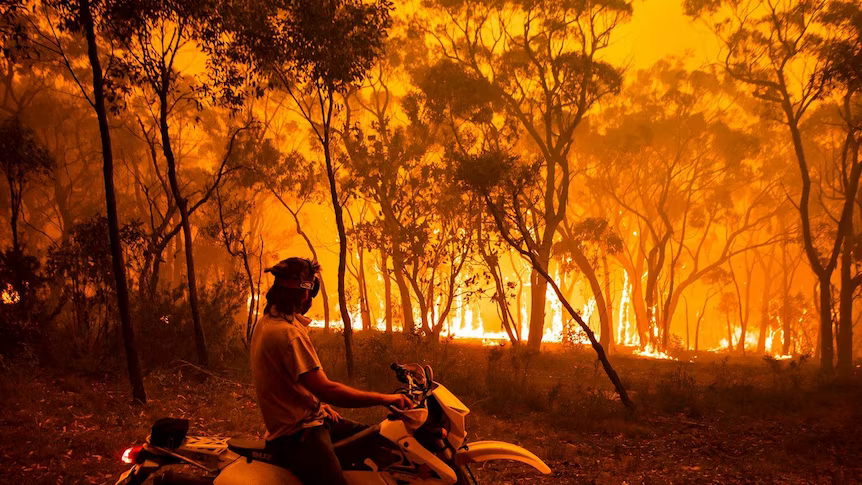
But that balance has been disrupted. Human activity, especially the burning of fossil fuels like coal, oil, and gas, has driven dramatic changes to our climate. And we are now facing the consequences: longer droughts, water scarcity, severe fires, rising sea levels, flooding, ocean acidification, melting polar ice, catastrophic storms, and declining biodiversity.
Here in Australia, we are already living the impacts of a warming planet. Extreme weather events - bushfires, floods, storms, and shifting rainfall patterns - are growing in intensity and frequency. Food systems are increasingly under pressure, and the cost of living continues to rise, with higher prices for electricity, gas, and everyday essentials affecting people across the country.
Climate change played a significant role in the devastating Black Summer bushfires of 2020 and the Lismore floods of 2022. In the past decade, temperatures around the Great Barrier Reef have reached their highest levels in four centuries, leading to five mass coral bleaching events in just nine years due to extreme heat, while in South Australia, warming waters have contributed to widespread algal blooms devastating marine ecosystems.
We also know that the impacts of climate change are not felt equally. Throughout the world, it is those with the least resources who have often contributed least to the problem that are often being impacted harder and faster, this includes Australia’s First Nations peoples, our Pacific Islander neighbours, and the poor in low income countries.
First Nations Peoples
- Ancestral homes and sacred sites are under threat due to sea level rise and storm fronts
- Many communities lack the quality of housing and infrastructure needed to adapt to ever-increasing temperatures and climate variability.
- Impacts of climate change threaten to turn many Aboriginal and Torres Strait Islander peoples and communities - the world’s oldest, living, continuing cultures - into internally displaced climate refugees.
Pacific Islander Neighbours
- Possibility of displacement also remains an existential threat
- Sea levels are rising and powerful and unpredictable weather events such as severe flooding and cyclones are destroying the livelihoods of vulnerable communities
- Extended droughts are making staple crops harder to grow, increasing the cost of food and living.
Children growing up today, are also already experiencing the impacts of climate change
- They are more vulnerable to being physically or psychologically harmed in a sudden onset of natural hazard than adults because their organs, muscles, and brains are less developed and therefore less resilient to impacts.
- Children are more likely to experience severe symptoms from vector-borne diseases and respiratory illnesses such as asthma, which can be linked to air pollution, including from greenhouse gas emissions
- A 2021 UNICEF survey found that 84% of young Australians included were extremely, very, or moderately worried about climate change, with almost half of those surveyed feeling distressed to the extent that it was affecting their daily functioning.
A child born in Australia in 2023 will experience four times as many heatwaves, three times as many droughts, and 1.5 times as many bushfires and river floods than a child born in Australia in 1960.
Australian Government’s National Risk Assessment 2025
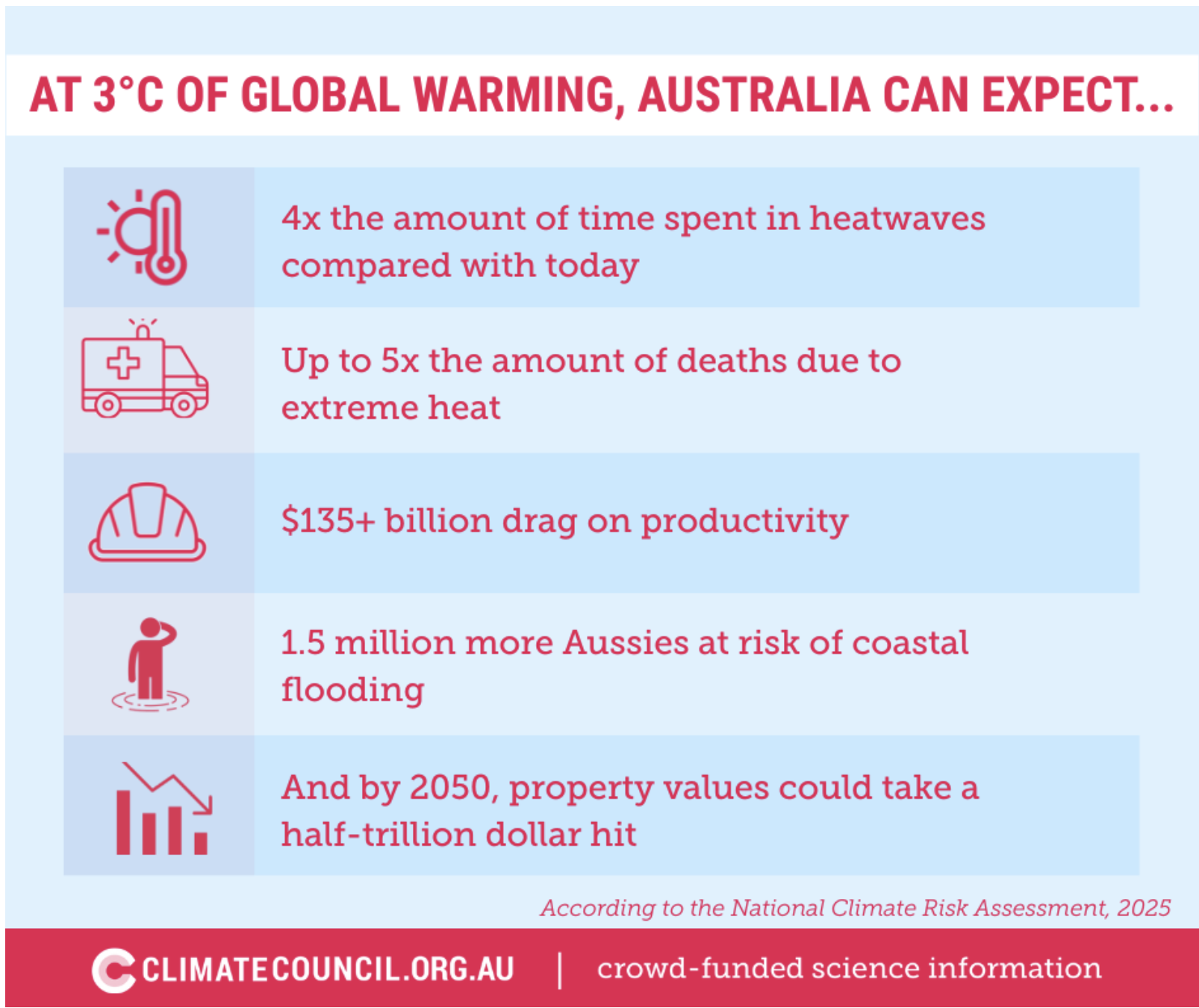
The Australian Government’s national risk assessment outlines the worst risks that Australia faces, from extreme heat, to flooding and drought, into the future.
It assesses climate risks and impacts in Australia at three levels of global heating: 1.5ºC, 2ºC, and 3ºC above pre-industrial levels. At these levels, it identifies severe risks with catastrophic impacts:
- Climate change will abruptly disrupt our way of life: “Changes in Australia’s climate will not occur gradually or smoothly. Reaching potential climate and ecological tipping points is very likely to result in abrupt changes”.
- Communities are likely to experience severe impacts: “It is likely we will experience more compounding, cascading and concurrent hazards”, like heavy flooding after a tropical cyclone, or bushfires and increased air pollution after extreme heatwaves.
The only solution is to rapidly slash climate pollution from coal, oil and gas, and replace energy sources with clean alternatives.
The rapid increase in climate action that we have seen since the ALP came to power in 2022 is commendable. We particularly note the Safeguard Mechanism, the Vehicle Efficiency Standard and increased renewable energy targets. These are welcome steps. But the science is clear: we must go further and faster in order to protect our future.
2035 Emissions Reduction Target
In September 2025, the Australian Government announced a 2035 emissions reduction target of 62–70% below 2005 levels, accompanied by a “Net Zero Plan.”
This target is not ambitious enough to meet the Paris Agreement’s goal of limiting global warming to 1.5 °C, with many experts suggesting cuts of 75% or more by 2035 are needed.
Concerns have also been raised about the government’s reluctance to commit firmly to the higher end of the target range, the possibility that the target may not be legislated, and a lack of clear plans for key sectors like transport and agriculture. Overall, the target risks leaving Australia vulnerable to more severe climate impacts and falling short of the urgent action climate science demands.
What We Are Asking:
With bold and urgent action, we can be part of mitigating the worst impacts of climate change and begin stabilising the climate now. We can also invest in ensuring our society adapts to those impacts that are now locked in, in order to protect our children and future generations. With a modern industrial and manufacturing base that is fit for the 21st century, we can also set up our kids to thrive with plenty of good, ongoing jobs in renewable energy and clean industries.
As a movement of individuals and churches, we are committed to personally reducing our ecological footprints.
Individual action matters, but we need bold, systemic change.
At our Let Justice Flow Conference in 2025, we will be calling on our nation’s leaders to take bold and urgent action to address climate change. We will ask them to:
1. Articulate a plan to end fossil fuel development and use
We call on the Australian Government to commit to and implement a fair, fast, and legislated national plan to phase out fossil fuel development and use, aligned with Australia’s international climate obligations
This plan must be grounded in a just transition for workers and communities that currently depend on fossil fuel industries, with strong public investment in renewable energy, sustainable jobs, and regional economic diversification.
Burning coal, oil, and gas is the primary driver of the climate crisis. Fossil fuels are responsible for over 75% of global greenhouse gas emissions, and nearly 90% of all carbon dioxide emissions.
Despite this, the Australian Government continues to support the expansion of fossil fuel projects, including new offshore gas fields, fracking operations, and coal mines - directly contradicting its own emissions reduction targets. Major projects such as Woodside’s Scarborough-Pluto development, Santos’ Barossa gas field, and the Beetaloo Basin fracking project represent carbon-intensive investments that endanger the climate, undermine our 2035 targets, and jeopardise the goal of net-zero by 2050.
Australia is a global fossil fuel powerhouse - the second-largest exporter of coal and liquified natural gas. The recent approval of the North West Shelf extension just days before announcing our updated Nationally Determined Contribution (mentioned above) is a betrayal of the Paris Agreement, and a slap in the face to our Pacific Island neighbours on the frontlines of climate impacts.
It is time for Australia to shift from laggard to leader. This transition must be ambitious, managed, and just, with strong public investment in renewable energy, sustainable jobs, and regional economic diversification.
We must start by ending fossil fuel exports and aligning national policy with the reality of the climate crisis.
2. Make big polluters pay
We call on the Australian Government to place a Climate Pollution Levy on coal, gas, and oil corporations, which could raise $46 billion a year, ensuring they pay their fair share towards climate action. These funds should then be used to establish a Climate Compensation Fund to meet the needs of communities on the frontline of climate impacts, and support everyday households facing rising costs from climate change and the clean energy transition.
Around the world and here in Australia, communities are already living with the devastating impacts of climate change: from extreme heatwaves and floods to more intense bushfires and rising costs of living. Those least responsible are being hit hardest, while the corporations most to blame for fuelling the crisis continue to profit.
The fossil fuel industry - coal, gas, and oil corporations - are among the most polluting and profitable companies on the planet. Australia’s coal, oil and gas corporations are making around $370 billion in revenue per year,
In Australia, these record profits have been driven by skyrocketing global prices, while emissions from their operations and exports continue to drive the climate emergency.
The Make Big Polluters Pay campaign calls for governments to hold these companies accountable for the harm they cause.
We call on the Australian Government to introduce a Climate Pollution Levy on fossil fuel corporations. This levy could raise an estimated $46 billion a year, ensuring big polluters contribute their fair share towards addressing the climate crisis.
Funds raised should be directed into a new Climate Compensation Fund - providing critical support for communities facing the worst climate impacts, especially First Nations communities and those in regional or disaster-prone areas. It should also help everyday households manage rising costs related to climate damage and the clean energy transition such as insurance, energy bills, and adaptation.
This is about fairness. Australians are paying the price of climate inaction through rising insurance premiums, higher grocery costs, and repeated disaster recovery. Meanwhile, fossil fuel giants pay little tax and avoid responsibility for the damage they cause.
The Climate Pollution Levy could be a powerful step toward justice, ensuring those who profit from pollution help pay for the solutions.
3. Expand access to the solar and battery scheme
We welcome the Government’s Cheaper Home Batteries Program as a valuable step toward lowering energy bills and accelerating the transition to clean energy.
To ensure the scheme is fair and inclusive, we urge the Australian Government to extend it to:
-
Low-income households
-
Renters
-
Social and community housing
-
Multi-unit dwellings
Expanding access will deliver cost-of-living relief to those most in need, close the clean energy gap, and support Australia’s broader climate and equity goals. This aligns with the principles of Renew Australia for All’s Energy Bill Savings Plan - ensuring no one is left behind in the renewable energy transition.
Context:
As Australia moves to decarbonise its energy system, solar power and battery storage are critical tools to reduce emissions and cut household energy bills. The Federal Government’s Cheaper Home Batteries Program is a welcome step toward empowering households to store renewable energy, lower electricity costs, and boost grid resilience.
However, without deliberate action to make this scheme inclusive, millions of Australians risk being left behind in the clean energy transition.
Currently, access to rooftop solar and batteries is largely limited to homeowners with the financial means to invest upfront. Low-income households, renters, residents of social and community housing, and people living in apartments or multi-unit dwellings face significant barriers - from cost, to infrastructure limitations, to landlord approvals.
This creates a clean energy divide that exacerbates inequality. Those who could benefit the most from lower energy bills are often locked out of access to solar and storage. At the same time, they’re disproportionately impacted by rising energy costs and climate-related expenses.
We urge the Australian Government to expand the Cheaper Home Batteries Program to ensure it delivers for those most in need. Doing so would bring immediate cost-of-living relief, while also supporting climate justice by ensuring all Australians can share in the benefits of clean energy.
This approach aligns with the Renew Australia for All Energy Bill Savings Plan, which calls for inclusive energy policies that prioritise equity and fairness. A truly national transition must leave no one behind.
Expanding access to solar and batteries is not just good climate policy, it is also smart economic and social policy. It will help reduce energy poverty, strengthen community resilience, and help ensure that every household, no matter their income or housing situation, can be part of Australia’s clean energy future.
Further Reading
If you would like to do a deeper dive into these issues, the following resources will be helpful for you:
- Climate Target Report by the Climate Council. The report emphasises that only a science-aligned target of net zero by 2035 and a 75% reduction in emissions from 2005 levels by 2030 can feasibly contribute to keeping global warming well below 2 °C. Weaker targets risk far worse outcomes. Strong targets offer reduced climate harm, economic benefits in clean industries, enhanced regional security, and cost-effective protection.
- Renew Australia for All Campaign details on the Energy Bill Savings Plan
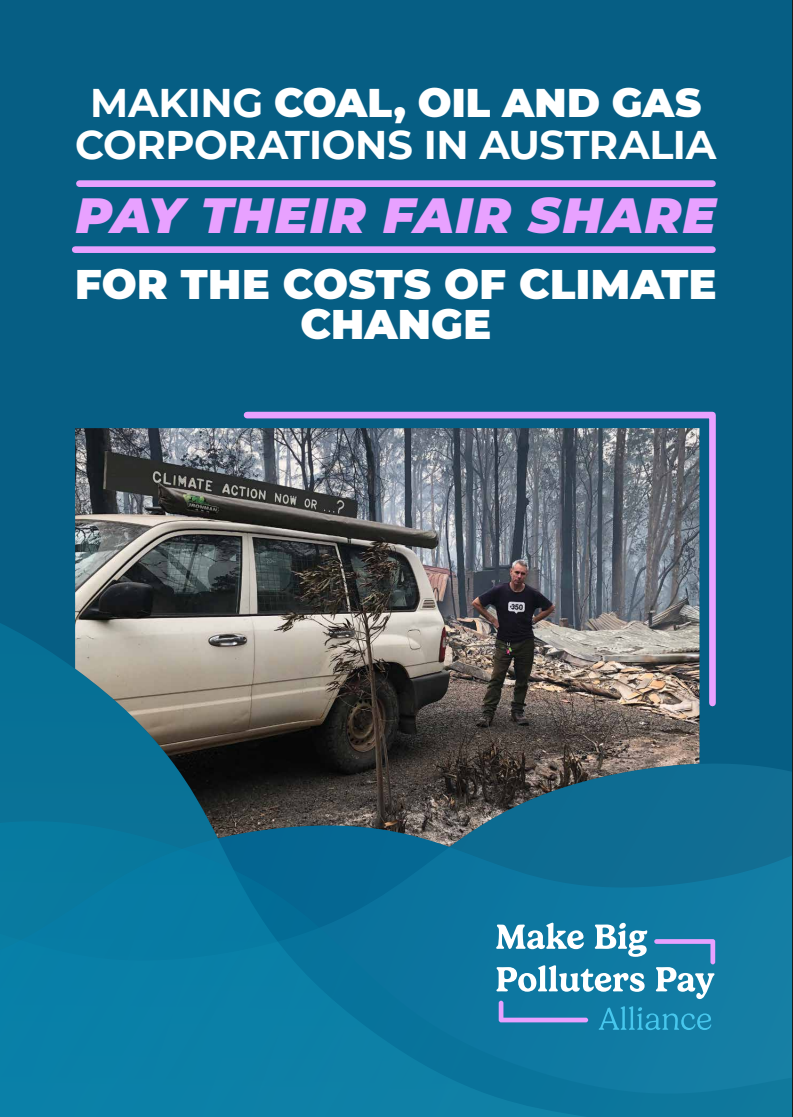
- Make Big Polluters Pay Alliance - Making Coal, Oil, and Gas Corporations in Australia Pay Their Fair Share for the Costs of Climate Change Report. This report positions Australia at a crossroads: either continue a system that lets corporations profit while society bears the costs or shift to a more just, accountable, and climate-resilient future. It argues that coal, oil, and gas corporations are the principal drivers of climate pollution in Australia and globally, yet they externalise nearly all the costs of their emissions onto communities, governments, and the environment. Meanwhile, corporations pay minimal taxes or royalties and continue to expand fossil fuel projects. The Make Big Polluters Pay Alliance call for structural reform to make these polluters pay their fair share