Rev. Nicholas Whereat's story
Rev. Nicholas Whereat shares his story of taking part in the End the Waiting Campaign, and the long road toward justice for people seeking asylum.

Rev. Nicholas Whereat shares his story of taking part in the End the Waiting Campaign, and the long road toward justice for people seeking asylum.
Rev. Nicholas Whereat, the End the Waiting Campaign, and the long road toward justice for people seeking asylum
For many in the Common Grace movement, the call to seek justice for people seeking asylum has been long, exhausting and deeply personal. It has involved prayer vigils and petitions, protests and quiet acts of care, heartbreak and persistence.
One person who has embodied that long, faithful commitment is Rev. Nicholas Whereat.
An Anglican priest for four decades, Nicholas has spent years standing alongside people seeking asylum - protesting offshore detention, meeting with politicians, and walking closely with people trapped in Australia’s immigration system for years on end.
But in recent years, his advocacy has taken on a deeply embodied form: fasting.
For Nicholas, this issue has never been abstract policy or political debate. It has always been about people.
Part of that conviction was shaped years ago while living in Brazil with his family. Even though they arrived with legal documents, support and stability, Nicholas remembers how difficult it still felt to settle into a new culture, learn a new language and live with the feeling of being visibly different and out of place.
At the same time, they came to know families living in nearby favelas and saw firsthand the hardship many people endured.
“We realised people don’t leave their country just because they’re poor to seek a better life,” Nicholas reflected.
That experience stayed with him. It deepened his compassion for people forced to flee home and challenged the simplistic narratives so often used in Australia’s refugee debate.
Back home in Australia, the story of one friend in particular has stayed with him - someone who feared for his life if returned to Iran and who had spent nearly a decade trapped in visa limbo in Australia, unable to move forward and unable to return home safely.
“He’d been in limbo for nine years, so I fasted for nine days.”
As the years in limbo progressed, so did the length of Nicholas’ fasts.
Last year, during the End the Waiting Campaign - coordinated by Common Grace and the National Council of Churches in Australia - Nicholas fasted for 12 days; 12 days to mark 12 years of limbo for his Iranian friend and all the others in limbo.
During this public witness, Nicholas stayed inside a cage he built himself - a confronting visual reminder of the dehumanisation experienced by many people subjected to Australia’s offshore detention system.
Attached to the cage were identification numbers referencing people detained offshore.
“The crime of this person is that he came by boat,” Nicholas reflected. “Dehumanisation is what this whole process is about.”
Nicholas’ fasts have become a powerful expression of grief, prayer, and solidarity - refusing to let people seeking asylum remain out of sight and out of mind.
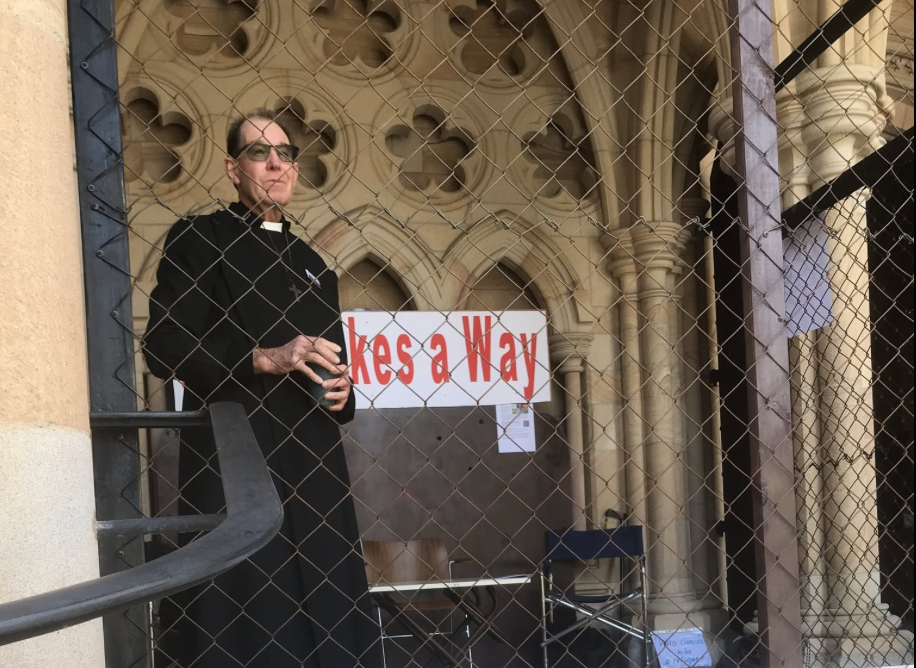
📸 Rev. Nicholas Whereat during his fast and lament outside the front of St John’s Cathedral. Credit Nicholas Whereat Facebook
The End the Waiting campaign helped bring renewed focus to one particularly urgent injustice in Australia’s immigration system: the thousands of people seeking asylum who had spent years trapped in uncertainty, unable to fully move forward with their lives.
At the heart of the campaign were more than 8,000 refugees and people seeking asylum - many failed by the now-abolished “Fast Track” system - who had spent up to 12 years living on temporary visas and short-term bridging visas, caught in ongoing limbo.
For years, people were left unable to plan for the future, separated from family members overseas, locked out of stability and permanent protection, and forced to live with the constant fear that safety could be taken away at any moment.
Again and again, advocates heard stories of exhaustion, fear and hopelessness from people stuck in limbo.
And for many involved in advocacy efforts, there were moments where change felt painfully far away.
“You’d go to rallies and protests and think - are we making any difference at all?” Nicholas reflected.
Yet over time, quiet signs of movement began to emerge.
Behind the scenes of the End the Waiting campaign, conversations began taking place. Long-stalled cases slowly started moving. Families who had spent years living with uncertainty began receiving long-awaited resolutions and the possibility of finally moving forward with safety and stability.
Importantly, much of this work has been happening carefully and quietly, with sensitivity for the people directly affected and awareness that public attention can sometimes bring further harm or politicisation.
Publicly available data shows that between when the campaign closed out in September 2025, and March 2026, more than 3,500 people (of the 8,000 mentioned previously) have since received Resolution of Status visas - granting them permanent protection here in Australia. We anticipate that over the last few months, these numbers have continued to rise. While many still remain in limbo, we celebrate that each of these people can at last begin to rebuild their lives without constant uncertainty and the fear of repatriation.
While significant challenges remain - especially for those still facing uncertainty and exclusion - there are many people today who are beginning to experience a future that once felt impossible.
For Nicholas, that reality brings both relief and sorrow.
“It’s exciting because these are people’s lives,” he said. “But it also means recognising that years of suffering never needed to happen.”
And reflecting on the role that prayer, fasting and persistent advocacy may have played, Nicholas simply said:
“You never know what prayer does.”
When asked what sustains him through this work, Nicholas returns again and again to faith.
He speaks of the repeated biblical call to care for the stranger, the refugee and the vulnerable, from the stories of Israel’s own displacement to Jesus’ words in Matthew 25.
“When we care for the foreigner, then we are doing what God is calling us to do as part of the Kingdom of God.”
For Nicholas, fasting became one expression of that calling: a refusal to become numb to suffering. A way of telling the truth about cruelty while still holding onto hope.
Reflecting on a quote from Musician Nick Cave, ‘Hope is optimism with a broken heart’ (The Red Hand Flies, issue 308) Nicholas described hope this way:
“Hope is what you go to when there’s nothing else.”
That kind of hope has sustained so many people in this movement over the years - people praying, advocating, fasting, protesting, learning, lamenting and continuing to believe that another way is possible.
That work continues.
And so does hope.
This reflection has been written with thanks to Rev. Nicholas Whereat in conversation with Eliza Johnson from the Common Grace team, and offers a snapshot of the wonderful and passionate movement of Common Grace and ways people are pursuing Jesus and justice together across these lands. If you have a story to share of how you or your community have been inspired and taken action with Common Grace, we would love to hear! Please reach out to our team at [email protected]
The Rev’d Nicholas Whereat currently works at the Anglican Parish of St Francis of Assisi Nundah and is a member of the Third Order of the Society of St Francis, an internation Franciscan community within the Anglican Church. Nicholas has a Bachelor of Theology from the Brisbane College of Theology, and he has trained as a Spiritual Director and Supervisor. Nicholas is passionate about the plight of refugees.

Eliza Johnson is the policy coordinator for Common Grace. Eliza has more than a decade of experience working in advocacy across a range of international development and human rights organisations. Eliza has expertise in advocacy and campaigning, research and policy, and a particular passion for making policy and political systems accessible and meaningful for everyone. She is also passionate about helping people join the dots between their love for Jesus and the call towards justice. Eliza has degrees in law and politics and a Master’s in Human Rights Law and Policy. She lives on beautiful Wangal Country with her husband and young family.

Rev. Nicholas Whereat shares his story of taking part in the End the Waiting Campaign, and the long road toward justice for people seeking asylum.

Kelli Hughes shares her story of welcoming and advocating for people seeking asylum in Australia, including taking part in the #EndTheWaiting prayer vigils in 2025.

Rev. Dr. John Jegasothy's journey from refugee to advocate reminds us that welcome transforms lives—and strengthens our communities.

James Harris shares the story of Atta, an Afghan refugee who received his permanent residency in Australia after 14 years of waiting.